OLED vs Mini-LED Displays Explained
OLED vs Mini-LED presents a clear trade-off. OLED delivers true per-pixel control and deep blacks, while Mini-LED offers brighter highlights with dense local dimming. Each technology has its own strengths in color accuracy, uniformity, and durability, plus practical considerations like price and availability. The choice hinges on use case and expectations for image stability over time. For a complete picture, the discussion continues beyond the basics.
OLED and Mini-LED: What They Are in Plain Language
OLED and Mini-LED are two technologies used to illuminate displays, but they differ in how they create and control light.
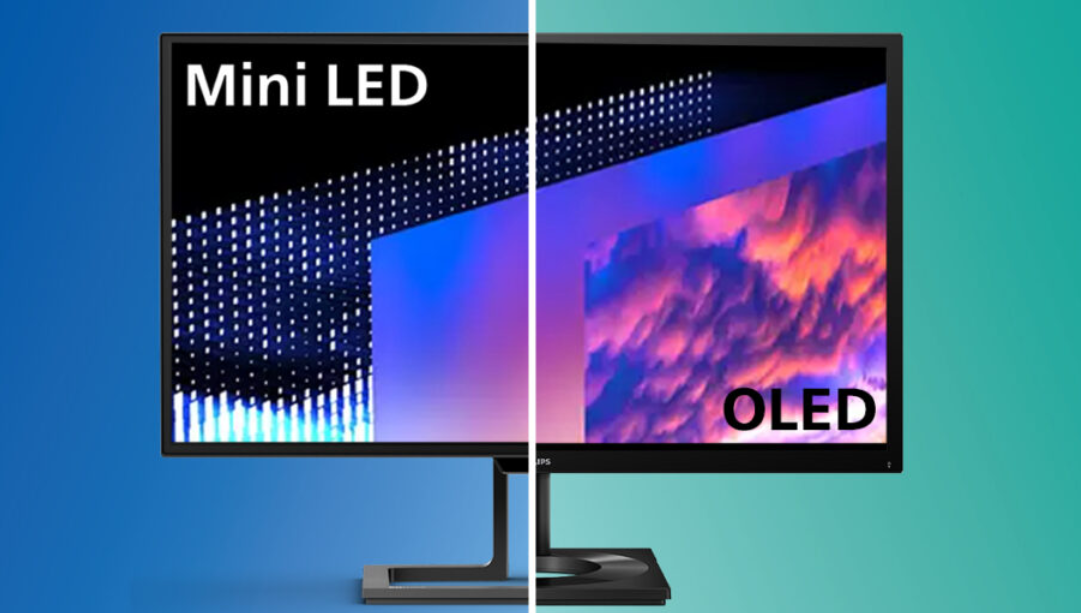
The piece explains that OLED emits light from organic pixels, enabling true blacks, while Mini-LED uses LEDs behind an LCD for local dimming.
This outlines OLED vs Mini LED and highlights panel tech differences in a concise, accessible way.
How Brightness and Contrast Differ in Practice
Brightness and contrast behave differently in practice depending on the underlying technology: OLED panels deliver true, per-pixel control over light, yielding infinite contrast because each pixel can be completely turned off, while Mini-LED-equipped LCDs achieve high peak brightness and strong local dimming through many small LEDs but cannot attain perfect black due to residual light spill.
This drives distinct time contrast and brightness dynamics.
See also: NFC vs Bluetooth: What’s the Difference?
Color Accuracy, Uniformity, and Durability to Expect
Color accuracy, uniformity, and long-term durability are critical for evaluating OLED and Mini-LED displays, since perceptual quality hinges on consistent color reproduction across the panel, stable grayscale performance, and resilience to aging effects.
The discussion emphasizes color stability, viewing angles, brightness uniformity, and image persistence as measurable facets shaping real-world experience and reliability for diverse viewing scenarios.
Price, Availability, and Which Tech Fits Your Use Case
For many buyers, price and availability ultimately determine which display technology can be adopted within real-world constraints, even when performance characteristics are favorable.
The analysis compares OLED and Mini-LED costs, supply stability, and lifecycle considerations, noting market volatility and warranty terms.
Decision criteria address use case alignment, such as gaming, cinema, or professional workflows, while acknowledging unrelated topic, off topic concerns in budgeting.
Frequently Asked Questions
Will OLED Burn-In Become More Common Over Time With Real-World Use?
OLED burn-in is unlikely to become prevalent due to real world usage, as modern panels include pixel shifting, refresh controls, and durability improvements; however, isolated instances may occur in static image scenarios, requiring mindful usage and long-term monitoring.
Which Tech Scales Better for Large-Format Gaming Monitors?
Juxtaposition frames the debate: OLED scaling promises uniform contrast, yet Mini LED scaling offers robust brightness without burn-in risks; for large-format gaming monitors, Mini LED scales more reliably while OLED scales aesthetically.
How Do OLED and Mini-Led Perform Under HDR at 120 Hz?
OLEDHDR 120hz delivers strong contrast and fast response with cinematic HDR, but risk of brightness mid-range blooming under prolonged gaming. MiniLEDHDR 120hz offers higher peak brightness and uniform HDR across large panels with less burn-in concern.
Are There Reliable Repair Options if Either Display Panel Fails?
A hypothetical repair case shows reliability concerns: panel failures occur sporadically, prompting manufacturers to offer warranty, replacement, or repair options. For both OLED and Mini-LED, repair options exist but vary by model; reliability concerns influence feasibility and cost.
Do Gaming Consoles Optimize Automatically for OLED or Mini-Led Panels?
Gaming consoles do not universally auto-optimize for OLED or Mini-LED; they rely on built-in presets and system-wide calibration. In practice, gaming calibration and automatic brightness adjustments vary by device, requiring manual fine-tuning for optimal panel performance.
Conclusion
In the end, OLED and Mini-LED illuminate different priorities: one prizes absolute blacks and uniform grayscale, the other sheer brightness with deft local dimming. OLED’s self-emissive pixels consult quiet, enduring clarity; Mini-LED’s backlit array pursues vivid, punchy detail under bright conditions. Durability and aging sharpen the trade-off, cost and availability tilt the scales, yet neither is universal. For cinema-grade immersion, OLED holds sway; for bright rooms or gaming at high luminance, Mini-LED proves compelling. Choice, then, mirrors use-case, not virtue.